 Tracing the origins of the human race has been one of the major areas of scientific endeavour ever since Darwin produced his theory of the origins of species. The Leakey discoveries in East Africa from prompted a vigorous search for the "missing link" - resulting in the discovery of "Turkana Boy" in 1984 - a 10 year old boy who lived 1.6 million years ago.. His tribe were fire users and had been using stone tools for a very long time. He belonged to a group of accomplished hunters and his "species" - usually called ergaster - was probably king of the savanna. But at 880 cc his brain size was very much larger relative to his size than any species who had gone before. He was essentially us, with a smaller brain and a peculiar head.
We have suggested that in fact modern humans could breed with erectus who lived almost a million years ago, that we are the same species with different heads, and that therefore the focus on sapiens is perhaps not the most important, at least in physical and evolutionary terms. It is erectus ergaster that is the evolutionary miracle.
The focus of this piece is the physical adaptations that led from other apes to erectus. The most important evolutionary innovations that distinguish us from the other primates, the ones where genetics and selection must be the prime determinants, as I see it, are:
- bipedal gait, and various forms of manual dexterity including "power and precision grip", clubbing and throwing
- bare skin and sweat glands - the "Naked Ape"; permitting distance running
- the large brain and everything that goes with it.
Preamble - the world in which erectus developed
The rise of homo has its genesis in a geological event of global scale, the crash of India into Asia and the uplifting of the Tibetan plateau. which reached its peak about six million years ago. The billions of tonnes of newly exposed rock from this collision soaked carbon dioxide out of the air to one of the lowest levels ever,. This cooled the climate gave an advantage to plants using the C4 photosynthesis pathway, mostly grasses. These had been present for over 25 million years, but it was only at this time that the true savanna belts that spanned Africa and Asia developed. These grassy lightly wooded plains became home to millions of hoofed grazing animals, replacing the earlier browsers who fed on forest vegetation, and to carnivores able to take advantage of this huge new source of food.At the same time, rapidly changing climate conditions and the emptying and subsequent filling of the Mediterranean caused at first very wet conditions then drying and cooling conditions across Northern Africa. Broadleaf forest replaced rainforest and was replaced by woodland and savanna, stretching in a changing mosaic of habitats.
Several hundresd species of apes had become widespread in the forests in the preceding Miocene era and now some of them adapted to woodland, savanna and even desert. As well as the baboon who has shown itself able to adapt with different foraging tactics to living in a wide variety of plains environments, new species of highly mobile, upright bipedal apes appeared that eventually spread worldwide into every type of habitat.
Innovation 0. Bipedalism
Four legs good, two legs betterThere is an argument, based on orangutan behavior (Thorpe et al. 2007) that straight leg walking is actually the ancestral behaviour of primates living in rainforest canopies, and that chimpanzees and gorillas discontinued it when living in more open forest in favour of knuckle walking. At any rate, straight legged bipedal primates with a brain capacity not much different from a chimpanzee entered the open savanna from about four million years ago and continued there until about two million years ago.
The number of finds of these very early small brained upright apes living in open areas has been few, and the finds in different areas have tended to be named not just as separate species but separate genera; we will refer to them generically as australopithecines. The sequence of descent is very far from being established, but there is no doubt the wide range of changing habitats in Africa at the time led outlier groups of forest apes to become specifically adapted for various conditions, and to expand into new areas as climate changed.
Upright walking was virtually a prerequisite for advanced tool use, since it freed the hands for other activities. At some point around 3 million years ago a small-brained ape learned how to chip stone flakes using other stones and to use these for cutting (see the example of Kanzi below), and homo set upon the long path of growth and technological progress.
Innovation 1. Precision and power grips
These hand functions are essential to tool making and use. "Only humans are able to apply the considerable force necessary for holding objects securely and steadily pinched between the thumb and one or more fingers", to apply the "three jawed vice" of the opposable thumb and several fingers. A few monkeys and apes can apply the secure "power grip", where a cylindrical object such as a hammer haft is seated in the closed palm and locked in with the thumb.It is disputed that the short bipedal homo precursor australopithecines, who lived in Africa between 4 million and 2 million years ago could use tools more successfully that any other ape, or were hunters. However Moya-Sola et al (1999) maintain that the hand of australopithecines had some of the features of "precision pinch" while the bipedal ape Oreopithecus who lived in Sardinia 5 million years earlier had this capability, and they suggest it was in fact co-evolutionary with habitual bipedalism and food gathering. A contemporaneus hominid ape Orrorin in Kenya had a longer thumb than the australopithecines, making secure grasp possible.
Innovation 2 Throwing and clubbing
These skills are stated by Young (2003) to promote reproductive success strongly, through establishing dominance, obtaining food, defending against predators and other hominid groups, and because it combines well with bipedalism (also noted by Darwin in 1871). These outcomes certainly hold among humans though they have not been observed among other apes. Spears and clubs are actually a tremendous advantage when handled well - today a Masai warrior can stop a charging buffalo or lion with a braced spear and can drive off a marauding elephant with a well thrown knobbed club (personal observation). Young suggests this is the earliest hominid specialisation.While accurate throwing of spears requires the precision grip, forceful throwing requires the application of leverage from the elbow and wrist flick, assisted by rotation of hips and shoulders. A chimpanzee throws stones and other materials, but usually underhand at no more than 20 mph, whereas a twelve year old human child can reach three times that speed, javelins are released at 70 mph, and cricket bowlers and baseball pitchers reach 90 mph or more.
There are almost as many opinions as to when humans gained the accurate throwing ability as paleontologists. Roach (2013) says that erectus had the skill two million years ago, Larsen says it probably evolved several hundred thousand years ago, while Finlayson (2009) thinks it is peculiar to sapiens and is what helped them out-compete the neanderthals.
Innovation 3. Bare skin and sweat glands - persistence hunting
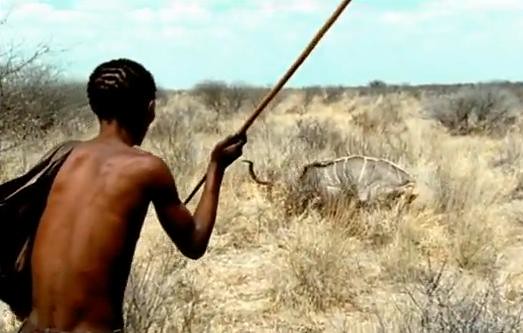
We think that early homo (who in the absence of information regarding speciation we shall call homo habilis), had learned a hunting trick still performed today by the San (Bushmen) people which requires persistence and endurance, not a great deal of coordination between hunters, little in the way of tools except a water carrier for fluid replenishment, and the specialised skill of tracking.
The San run down game which would normally be asleep in the shade in the heat of the day. Hunters spend two to five hours harassing an animal over twenty miles until it finally collapses from heat exhaustion. Persistence hunting can be used successfully against the fastest animals - even the cheetah.
We can do this because we are heat-adapted, with tall narrow bodies, profuse sweat glands, "bare" skin with sweat glands for cooling and fine "vellus hair" which acts as a wick for evaporation. So we can keep running for hours in hot conditions, unlike other animals[1] who need to stop and pant to throw off heat. The technique was probably our first hunting method after adopting bipedalism, since our ability to do the quick charges required for ambush hunting was diminished by the upright gait.
The technique only works in hot open places with daytime temperatures around 40oC and is only recorded in Africa, Australia and Mexico. Although it expends a great deal of energy, oxygen and moisture, (Carrier 1984) it has a very high success rate compared with other hunting methods and in terms of meat yield is only beaten by hunting with dogs (Liebenberg 2006).
Eating easily digested meat substantially reduces the necessity for digestion and provides energy for other innovations - such as the Big Brain. The loss of body hair and the development of sweat glands in carnivorous bipeds without technologies such as the spear thrower, trapping or dogs must be strongly selected in hot places.
It is suggested by Liebenberg that tracking is such an advanced skill that long-distance running may have evolved while scavenging rather than in hunting, and was developed for beating other animals to the carcass. But in scavenging there is not such an obvious genetic advantage for hair loss and sweat gain.
The loss of body hair, a basic mammal characteristic which assists in the maintenance of a steady body temperature, leaves humans at a fairly significant disadvantage in terms of adaptability to alternative environments and climate change, and a random observer of the time might well have assumed that these new hairless creatures were painting themselves into an evolutionary dead end, trapped in a single environment.
From the start there was a need to develop skin pigmentation to protect against deadly and damaging UV rays. Hominims probably discovered very early they could wear skins for protection against the cold, allowing them to head for colder regions. However the need to maintain a correct Vitamin D/folate balance in producing healthy infants has meant that humans have needed to alter their skin colour quite quickly in different latitudes. The Chimpanzee Sequencing and Analysis Consortium has discovered that the genes for skin colouration in humans are among the most significantly modified from those of the chimpanzee,
Because women are not known to hunt, this theory might predict that men were the ones that needed to be hairless, when in fact women have much less body hair than men. Darwin thought that sexual dimorphism was the reason for the male beard and female hairlessness, stating that men prefer women without body hair. We remain skeptical of sexual selection by the human male, who is demonstrably not particularly fussy when it comes to mating. However - it does remain odd that erectus kept this innovation even when it learned better ways to hunt and when it moved to zones where it was useless - so sexual selection might have payed a role here. It could also have helped with speciation from australopithecus (presuming homo is in fact a species). Otherwise it is hard to see how it happened, as the two species were neighbours for at least a million years without one wiping out the other or (apparently) forming hybrids..
There is also the possibility that the loss of pelt was even earlier than habilus, stemming back to the time when fully bipedal apes entered the plains. Many apes have large bare areas for sweating and cooling, and an expansion of this capacity in bipedal apes is not a really major innovation. As we have no way to check which hominims had pelts - except to say that tropical hunters such as habilus and ergaster probably did not - this debate will remain unresolved.
Apes show a very large variation in brain capacities. The cranial capacity of gorillas, for instance, varies from 340-750 cc. No doubt they could be bred to favour the larger end of this range without much in the way of genetic modification, but there is no selection pressure for them to do so.
The various australopithecines had average brain sizes fairly similar to a chimpanzee, around 400cc. We have only a few samples for erectus, but if the average brain size was double this, then even allowing for the increase in stature it represents a very substantial physical modification. Exactly why and where this happened is a matter for conjecture.
Humans have an extremely long period of immaturity compared with other species, and each human reaching adulthood requires a very high investment by parents and the rest of the tribe. It has been suggested that Turkana Boy, with his smaller brain, was considerably nearer maturity than a modern child of his age.
Overall - the extra food required per individual consumed because of the large brain - directly; through natality loss and damage, and from the extra time spent caring for children and taken away from food gathering, is probably of the order of 40 per cent. In other words, other things being equal, large brained hominids could only sustain about sixty percent of the population of a smaller brained equivalent. Clearly, other things were not equal, but exactly what is speculative.
To me, there is only one answer. Many evolutionary biologists focus only on advantages to individuals - but advantages to whole communities are more beneficial and quicker in assimilating and transferring genes. Humans are a social animal and the positive effects of higher intelligence are greatly magnified in company. The bigger brain permits division of labour - largely unknown in other species - and gives time to individuals to develop specialised techniques and make new discoveries which can be shared with the whole group.
In particular any band with several intelligent and empowered members is at a considerable advantage over other bands in terms of access to resources, trade, negotiation and the conduct of warfare, and over predators in terms of maintaining vigilance and organising defence. The whole band does not have to be intelligent, and the mutation can act to the advantage of even the less intelligent or adaptable members of the band well before it is fixed in the whole group. Because the intelligent members will be high-status and perhaps better able to negotiate courtship, they will mate quickly and their genes will spread through the group as it prospers.
Evidence is that early homo was not at the top of the food chain - the hominims from Georgia and habilis in Africa have been found eaten in the dens of extinct cat species. The battle between cats and hominims may have been a factor in the evolution of both.
Today, leopards are expert primate hunters and are quite effective in attacking and disembowelling baboons; they may try to attack a human in the same way if the necessity arises. Baboons are particularly gregarious and unlike most apes live in multi-male groups - typically about 50 which is also believed to be the preferred size of proto-human bands. Like hominims they live on the plains with no cover, and the big-toothed males protect against and drive off big cat predators (Busse 1980). Australopithecene males were considerably bigger than the females and probably did the same thing. Modern big cats appeared about the same time as early humans, adapted for hunting the game including primates that had appeared on the new savanna grasslands , and one might speculate they evolved together, with cats developing more deadly ambush skills and humans developing bigger brains and better organisation to compensate.
A standard joke in the game lodges of Kenya is a book called "The Most Dangerous Animal in Africa". When you open it you find a mirror. It has always been my contention that because humans arose amidst the fiercest and most dangerous animals on earth, where they survived and eventually prevailed, that when they expanded into other areas they made short work of the local megafauna, which stood no chance.
The San run down game which would normally be asleep in the shade in the heat of the day. Hunters spend two to five hours harassing an animal over twenty miles until it finally collapses from heat exhaustion. Persistence hunting can be used successfully against the fastest animals - even the cheetah.
We can do this because we are heat-adapted, with tall narrow bodies, profuse sweat glands, "bare" skin with sweat glands for cooling and fine "vellus hair" which acts as a wick for evaporation. So we can keep running for hours in hot conditions, unlike other animals[1] who need to stop and pant to throw off heat. The technique was probably our first hunting method after adopting bipedalism, since our ability to do the quick charges required for ambush hunting was diminished by the upright gait.
The technique only works in hot open places with daytime temperatures around 40oC and is only recorded in Africa, Australia and Mexico. Although it expends a great deal of energy, oxygen and moisture, (Carrier 1984) it has a very high success rate compared with other hunting methods and in terms of meat yield is only beaten by hunting with dogs (Liebenberg 2006).
Eating easily digested meat substantially reduces the necessity for digestion and provides energy for other innovations - such as the Big Brain. The loss of body hair and the development of sweat glands in carnivorous bipeds without technologies such as the spear thrower, trapping or dogs must be strongly selected in hot places.
It is suggested by Liebenberg that tracking is such an advanced skill that long-distance running may have evolved while scavenging rather than in hunting, and was developed for beating other animals to the carcass. But in scavenging there is not such an obvious genetic advantage for hair loss and sweat gain.
The loss of body hair, a basic mammal characteristic which assists in the maintenance of a steady body temperature, leaves humans at a fairly significant disadvantage in terms of adaptability to alternative environments and climate change, and a random observer of the time might well have assumed that these new hairless creatures were painting themselves into an evolutionary dead end, trapped in a single environment.
From the start there was a need to develop skin pigmentation to protect against deadly and damaging UV rays. Hominims probably discovered very early they could wear skins for protection against the cold, allowing them to head for colder regions. However the need to maintain a correct Vitamin D/folate balance in producing healthy infants has meant that humans have needed to alter their skin colour quite quickly in different latitudes. The Chimpanzee Sequencing and Analysis Consortium has discovered that the genes for skin colouration in humans are among the most significantly modified from those of the chimpanzee,
Because women are not known to hunt, this theory might predict that men were the ones that needed to be hairless, when in fact women have much less body hair than men. Darwin thought that sexual dimorphism was the reason for the male beard and female hairlessness, stating that men prefer women without body hair. We remain skeptical of sexual selection by the human male, who is demonstrably not particularly fussy when it comes to mating. However - it does remain odd that erectus kept this innovation even when it learned better ways to hunt and when it moved to zones where it was useless - so sexual selection might have payed a role here. It could also have helped with speciation from australopithecus (presuming homo is in fact a species). Otherwise it is hard to see how it happened, as the two species were neighbours for at least a million years without one wiping out the other or (apparently) forming hybrids..
There is also the possibility that the loss of pelt was even earlier than habilus, stemming back to the time when fully bipedal apes entered the plains. Many apes have large bare areas for sweating and cooling, and an expansion of this capacity in bipedal apes is not a really major innovation. As we have no way to check which hominims had pelts - except to say that tropical hunters such as habilus and ergaster probably did not - this debate will remain unresolved.
Innovation 4. Large brain
Primates already have much larger brains for their size than other animals, developed probably to handle hand-eye co-ordination and to calculate trajectories in a challenging three dimensional arboreal setting, Tricolour vision, which makes it possible to distinguish fruits and red immature leaves, may also require extra brain power.[1] Developing even larger brain sizes probably required nothing more than enhancement/duplication of genes already present in the apes, or even just breeding selection for larger-brained individuals.Apes show a very large variation in brain capacities. The cranial capacity of gorillas, for instance, varies from 340-750 cc. No doubt they could be bred to favour the larger end of this range without much in the way of genetic modification, but there is no selection pressure for them to do so.
The various australopithecines had average brain sizes fairly similar to a chimpanzee, around 400cc. We have only a few samples for erectus, but if the average brain size was double this, then even allowing for the increase in stature it represents a very substantial physical modification. Exactly why and where this happened is a matter for conjecture.
The disadvantages of a bigger brain
The big brain is a huge disadvantage for breeding individuals, which is probably why no other animal than homo has developed it. It does not confer enough fitness in itself relative to its high maintenance costs - a quarter to a fifth of the total energy and oxygen consumed. As well it has a very large cost in terms of natal difficulties and nurture. Because human babies have such big heads, humans find birthing far harder than other apes and there are frequent birth casualties for both mother and child.Humans have an extremely long period of immaturity compared with other species, and each human reaching adulthood requires a very high investment by parents and the rest of the tribe. It has been suggested that Turkana Boy, with his smaller brain, was considerably nearer maturity than a modern child of his age.
Overall - the extra food required per individual consumed because of the large brain - directly; through natality loss and damage, and from the extra time spent caring for children and taken away from food gathering, is probably of the order of 40 per cent. In other words, other things being equal, large brained hominids could only sustain about sixty percent of the population of a smaller brained equivalent. Clearly, other things were not equal, but exactly what is speculative.
The advantages
It is not so easy to find compensating advantages. A decent set of teeth and claws and a fast charge is better value for solo hunting. Higher intelligence is helpful to survival in locating and processing new sources of food, for remembering the location of seasonally available foods, and in hunting and tracking technique, but it is not enough to justify the massive extra energy expenditure - to the point where some scholars have suggested it must be a sexually selected trait with females selecting more intelligent mates (though the lack of dimorphism is not encouraging, and the current behaviour of the human female does not lend much support).To me, there is only one answer. Many evolutionary biologists focus only on advantages to individuals - but advantages to whole communities are more beneficial and quicker in assimilating and transferring genes. Humans are a social animal and the positive effects of higher intelligence are greatly magnified in company. The bigger brain permits division of labour - largely unknown in other species - and gives time to individuals to develop specialised techniques and make new discoveries which can be shared with the whole group.
In particular any band with several intelligent and empowered members is at a considerable advantage over other bands in terms of access to resources, trade, negotiation and the conduct of warfare, and over predators in terms of maintaining vigilance and organising defence. The whole band does not have to be intelligent, and the mutation can act to the advantage of even the less intelligent or adaptable members of the band well before it is fixed in the whole group. Because the intelligent members will be high-status and perhaps better able to negotiate courtship, they will mate quickly and their genes will spread through the group as it prospers.
Evidence is that early homo was not at the top of the food chain - the hominims from Georgia and habilis in Africa have been found eaten in the dens of extinct cat species. The battle between cats and hominims may have been a factor in the evolution of both.
Today, leopards are expert primate hunters and are quite effective in attacking and disembowelling baboons; they may try to attack a human in the same way if the necessity arises. Baboons are particularly gregarious and unlike most apes live in multi-male groups - typically about 50 which is also believed to be the preferred size of proto-human bands. Like hominims they live on the plains with no cover, and the big-toothed males protect against and drive off big cat predators (Busse 1980). Australopithecene males were considerably bigger than the females and probably did the same thing. Modern big cats appeared about the same time as early humans, adapted for hunting the game including primates that had appeared on the new savanna grasslands , and one might speculate they evolved together, with cats developing more deadly ambush skills and humans developing bigger brains and better organisation to compensate.
A standard joke in the game lodges of Kenya is a book called "The Most Dangerous Animal in Africa". When you open it you find a mirror. It has always been my contention that because humans arose amidst the fiercest and most dangerous animals on earth, where they survived and eventually prevailed, that when they expanded into other areas they made short work of the local megafauna, which stood no chance.
So when and where did the big brain happen, if indeed it happened only once?
As large as you need and as small as you can
The great variety in sizes of brains (modern humans range from 900 to 1800cc) within any hominim group makes any comparison of sizes over time unpredictable. Some authors have said that size increased in two bursts - once from habilus to ergaster-erectus about 2 million years ago and again from erectus to early sapiens about 500 000 years ago. Others have said that the expansion in brain size was steady up till 300 000 years ago. Neanderthals definitely had larger brains on average (being the only hominim for which we have a significant sample).
We know there is a tradeoff between energy use/natal damage and brain size. There may have been overshoot of the optimal size; it is claimed that human brains have shrunk from an average 1500cc to 1350cc over the last 20 000 years. Various theories as to why this has happened are hard to substantiate.
Where it happened is anyone's guess - while most of the finds are in Africa there are a few in Europe and Asia but not sufficient to prove that later big brained hominims are descended directly from earlier small brained ones, which is part of the multiregional theory. Of course the out-of-Africa theory presumes that all significant advances took place in Africa.
Summary
The very small sample of hominid bones prior to about 30 000 years ago makes teh drawing of conclusions difficult, but the sequence of bodily adaptations that characterise humans are generally agreed to have taken place in the order:
Bipedalism => Power/precision grip and clubbing => human proportions, bare skin and sweat glands => accurate throwing, probably complete by 1.6 million years ago.
Average brain size continued to expand during the period, probably accompanied by increasingly complex forms of social interaction. The key innovations of tool chipping and fire setting can actually be carried out by a small-brained modern ape, and they probably took habitual form by the time of ergaster 1.6 million years ago.
Exactly what happened to the many forms of small proto-human australopithecines that shared Africa with early homo for a million years, disappearing about 2 million years ago, is unknown.
References
Blainey, G (1983). Triumph of the Nomads. (Pan Australia).Busse, C (1980).Leopard and lion predation upon Chacma baboons. Botswana Notes and Records 12.
Carrier, D R (1984). The energetic paradox of human running and hominid evolution. Current Anthropology 25: 483.
Chimpanzee Sequencing and Analysis Consortium (2005). Initial sequence of the chimpanzee genome and comparison with the human genome. Nature 437: 69-87.
Darwin, C (1871). The Descent of Man, and Selection in Relation to Sex. (London: John Murray).
Finlayson
Larsen, S (2013), opinion in http://www.nytimes.com/2013/06/27/science/evolution-on-the-mound-why-humans-throw-so-well.html
Liebenberg, L (2006). Persistence hunting by modern hunter-gatherers. Current Anthropology 24http://www.mattmetzgar.com/wp-content/uploads/2007/08/persistence_hunting.pdf
Moya-Sola et al. (1999). Evidence of hominid-like precision grip capability in the hand of
the Miocene ape Oreopithecus. Proc. Natl. Acad. Sci. USA Vol. 96, pp. 313–317
Roach (2013). Elastic energy storage in the shoulder and the evolution of high-speed throwing in Homo. nature 498: 483-6.
Thorpe, SKS, Holder R and Crompton RH. (2007) Origin of human bipedalism as an adaptation for locomotion on flexible branches Science 316:1328-1331.
Wranger, R (2009). Catching Fire: How Cooking Made us Human. Profile Books,
Young, R W (2003). Evolution of the human hand: the role of throwing and clubbing. Journal of Anatomy 202: 165-74.
TECHNOLOGICAL ADAPTATIONS
These are one-off technological advances that have been copied and learned,
Fire
Fire has been with us so long that it is actually responsible for several biological adaptations.Cooking breaks down the tough fibre in foods which can then be eaten and easily digested more easily. As a result we need a shorter gut than most mammals (Wranger 2009) - which allowed our long legs to develop, and freed up energy for the larger brain. Our teeth no longer needed to be as robust, and "modern" lighter dentition is probably an adaptation to the cooking of food.
Some foods such as grains and beans can only be eaten cooked as they contain toxins which are mostly destroyed by heating. The acquisition of fire therefore extended the types of foods that could be acquired, and extended the numbers and the range of humans. Collection of wild grass seeds by hunter gatherers on the plains eventually led to agriculture in suitable sites.
Fire has been the ultimate weapon in the hominim arsenal and it seems we probably had it by the time of Turkana Boy. Almost all animals are afraid of fire and a fire will keep large animals at bay - khoisan tribesmen in Botswana today will set a fire as soon as they see an elephant (personal observation). This may be the way we eventually obtained relief from predators.
The timing of the acquisition of fire is debated. Wildfires became much more common with the advent of open grasslands and savanna, and probably even australopithecus knew of its effects and scavenged charred animals. Perhaps some group of slightly bolder or more intelligent apes discovered how to fan embers to flame and cook freshly caught food, after a fire.
One might wonder whether australopithecus remained afraid of fire and would not approach early homo campsites, aiding in speciation. However some apes are considerably more adept at handling fire and tools than we would generally give them credence for. Kanzi, a bonobo in captivity, learned to collect firewood, light a fire with matches, set up a griddle and cook. He has learned about 500 words of sign language, and can break flint flakes and create tools for various purposes, using them as scrapers and drills.[2]
Lighting a fire with matches is one thing, but keeping and managing fires seems to be a peculiarly homo trait. Carrying embers around with a tribal group and keeping them alight requires a fair amount of perseverance and social organisation. Lighting a fire with basic materials requires a lot of skill, possessed by relatively few "civilised" people today.
The short gut and lighter teeth have been with us for several million years, which suggests an early acquisition date. Evidence around ergaster sites in East and South Africa is consistent with cooking and the regular setting of fires. Certainly by the middle paleolithic, all human tribes were practising maintenance of the landscape and hunting using fire, and cooked most of their food, as evidenced by many ancient fireplaces and greatly modified "modern" teeth.
[1] Horses, camels and kangaroos also sweat, as do most old world primates. Panting is more efficient in cooling the brain and conserving moisture - but it requires the animal to stop.
[2] New York Daily News 30 Dec 2011. Mail Online 23 August 2012.
[3] Birds, insects and tropical fish have even better colour vision, without requiring particularly large brains, so perhaps this is not a factor.
No comments:
Post a Comment