·
Is homo sapiens
actually a species?
·
Did homo sapiens
originate in Africa?
·
Are racial
differences due to admixtures from different groups of early humans?
In this post I deal with the first question.
We as humans presume we are a unique species. We regard
ourselves as substantially elevated above every other form of animal life – the
“people of the Book” in particular say that only Man has an immortal soul and
only Man was created “in the image of God”.
From a more scientific point if view – we certainly appear
to be a unique species. There is after all nothing around that looks much like
us. We cannot successfully mate with any other species – in fact the thought is
particularly abhorrent to humans everywhere, and even attempting to do so
attracts the most extreme sanctions.
But we strike complications when we look into our own
distant past. Since the 1850s remains of creatures known as hominims that are not like modern humans but closely
resemble us have been found, and now every time we look, some new species or
twist has been added to the lineage of early man. It is generally agreed that
these primitive species or subspecies are “not us” – but are they?
Homo erectus
"Erectus is not extinct, it is us"
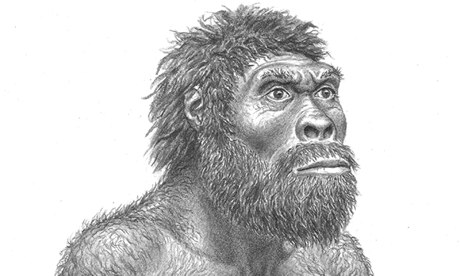 |
| Home erectus Mark #1. Illustration: J H Matternes Representations of erectus range from apelike to the "noble savage", but they are usually hairy, brutish and short. |
Homo erectus is an extinct species of hominin that lived throughout most of the Pleistocene, with the earliest first fossil evidence dating to around 1.8 million years ago and the most recent to around 143,000 years ago
The species changed a great deal during this very long
period; with brain size steadily growing from about 500 cc up to over 1500 cc
(modern humans have an average 1350 cc). Because of this, hominids from
different times and places are sometimes given different species names, like homo
habilus, rudolfensis, ergaster, heidelbergensis, rhodesiensis
etc
Five erectus skulls recently found in a site in Georgia[1]
where they has been dragged by an extinct canine predator show such different
features that all these early catogories seem unlikely and we are looking at
the one species, homo erectus.
Beneath the ruined medieval town of Dmanisi,
in the Republic of Georgia, scientists have discovered remains of ancient
rhinoceroses, saber-toothed tigers and, most remarkably, several early humans.
The hominid remains are about 1.8 million years old--the oldest well-documented
sample of human fossils found outside of Africa.
I go further and think the evidence is compelling that erectus
is not “extinct”, it is us.
The definition of a species does not hinge on skull shape,
teeth or even brain size or tool quality. A species is defined as “able to mate
and produce fertile offspring”. We now know that early sapiens was able to produce
fertile offspring with homonims that lived nearly a million years ago. These are generally agreed to be homo erectus in one of the forms or
subspecies named above.
 |
| Home erectus mark #60 000. Photo © J Flood |
[1] Skull
of Homo erectus throws story of human evolution into disarray. The Guardian, 18 Oct 2013.
Neanderthal and Denisovan admixture
"If humans can breed with neanderthals, they must also be able to breed with the common ancestor"
The heavy-set cold-adapted Neanderthals occupied Europe from the time of "Swanscombe woman" in England 400 000 years ago, up until about 29 000 years ago in Gibraltar. To date, the bones of over 400 Neanderthals have been found in various sites around Europe and as far afield as Siberia. In the Levant (Israel and Lebanon) they occupied sites that were previously occupied by sapiens, in a period when conditions had become colder and animals were present of the kind Neanderthals were familiar with further north.
The heavy-set cold-adapted Neanderthals occupied Europe from the time of "Swanscombe woman" in England 400 000 years ago, up until about 29 000 years ago in Gibraltar. To date, the bones of over 400 Neanderthals have been found in various sites around Europe and as far afield as Siberia. In the Levant (Israel and Lebanon) they occupied sites that were previously occupied by sapiens, in a period when conditions had become colder and animals were present of the kind Neanderthals were familiar with further north.

Over the succeeding years a number of conflicting theories
arose as to their origin and demise. Some thought the Neanderthals were our
ancestors and some not. The first mitochondrial DNA studies settled the issue
by showing that Neanderthals were a fairly uniform group, and quite a long way genetically from us, with a common ancestor about
350 000 years ago, well before anatomically modern humans existed. It is
thought, without any real evidence, that “Neanderthals left Africa about 300
000 years ago”.
Very recently a few small bones and teeth from another early
hominid lineage, the Denisovians, have been found in a cave in the Altai Ranges
of Siberia, surrounded by human and Neanderthal bones left there between 30 000
and 50 000 years ago. The Denisovan mitochondrian DNA is distinct from either
Neanderthal or sapiens.
The mtDNA from the Denisova
finger bone differs from that of modern humans by 385 bases in the mtDNA strand
out of approximately 16,500, whereas the difference between modern humans and Neanderthals is
around 202 bases. In contrast, the difference between chimpanzees and modern
humans is approximately 1,462 mtDNA base pairs. This
suggested a divergence time around one million years ago.
One bone from another individual was clearly Denisovan, but
diverged a great deal from the other, “as different as humans from different
continents” which prompted the thought that the second individual had
mitochondria descended from some even more ancient line.
The mtDNA analysis
further suggested this new hominin species was the result of an early
migration out
of Africa, distinct from
the later out-of-Africa migrations associated with Neanderthals and modern
humans, but also distinct from the earlier African exodus of Homo erectus”[1]
Later, the researchers were able to sequence almost a
complete Denisovan nuclear genome, showing that Denisovans and Neanderthals were
more closely related to each other than to us.
A sequencing of the complete genome of Neanderthalus, taken
by splicing together remaining DNA from several individual, was undertaken in 2008. [3] It showed that modern humans – everywhere except for two African samples – had about 4 per cent Neanderthal admixture
in their genes. Similarly, about 4 to 6 per cent of Melanesian DNA appears to
come from the Denisovans, with a lesser
amount admixed with Australian Aboriginal DNA and some “negrito” populations of
South-east Asia.
An important corollary of this admixture is that sapiens is not a species. The usual criterion for a species is “able to produce fertile offspring”. If sapiens 80 000 years ago were able to breed successfully with neanderthals and denisovans, then they are all from the same species. Something even more stunning is immediately implied. If humans can breed with neanderthals, they must also be able to breed with the common ancestor of 800 000 years ago, who is only half the genetic distance away.
An important corollary of this admixture is that sapiens is not a species. The usual criterion for a species is “able to produce fertile offspring”. If sapiens 80 000 years ago were able to breed successfully with neanderthals and denisovans, then they are all from the same species. Something even more stunning is immediately implied. If humans can breed with neanderthals, they must also be able to breed with the common ancestor of 800 000 years ago, who is only half the genetic distance away.
To see this – starting from 80 000 years ago, the number of
generations from sapiens back to the common ancestor is about 24 000. There is
another 24 000 down to the Neanderthal, so the successful breeding is taking
place with someone 48 000 generations away. It must therefore be easy to breed
with the common ancestor who is only 24 000 generations away on the same
lineage.
Therefore humans must have been able to breed with homo erectus living long ago. We are all therefore the same species, which might as well be
called homo erectus - homo erectus sapiens, homo erectus neanderthalus, homo erectus denisovus, and any other
erectus subspecies that may subsequently be identified by genetics.
Human is as human does. If erectus was just us, then they behaved like us. Namely they formed hundreds of thousands of little tribes over their two million year history, some of whom were isolated and who over time formed subspecies. They were highly aggressive, xenophobic, quarrelsome and destructive. They were prone to launching into military adventures every time they got some organisational or technical advantage, and went on long romps across the globe, destroying everything in their path. They stole women and took slaves on a large scale, and regarded other tribes as laughably inferior, even sub-human, something to be exploited. They carried diseases during their excursions which wiped out most members of other populations, leaving them ripe for conquest. Some tribes probably ate each other for religious purposes, and they all performed atrocities. They also developed many lost and colourful cultures, they spent most of their time happily enjoying their lives with their families and neighbours, and they performed random acts of hospitality and kindness to strangers.
Human is as human does. If erectus was just us, then they behaved like us. Namely they formed hundreds of thousands of little tribes over their two million year history, some of whom were isolated and who over time formed subspecies. They were highly aggressive, xenophobic, quarrelsome and destructive. They were prone to launching into military adventures every time they got some organisational or technical advantage, and went on long romps across the globe, destroying everything in their path. They stole women and took slaves on a large scale, and regarded other tribes as laughably inferior, even sub-human, something to be exploited. They carried diseases during their excursions which wiped out most members of other populations, leaving them ripe for conquest. Some tribes probably ate each other for religious purposes, and they all performed atrocities. They also developed many lost and colourful cultures, they spent most of their time happily enjoying their lives with their families and neighbours, and they performed random acts of hospitality and kindness to strangers.
[1] Katsnelson, Alla (24 March 2010), "New hominin found via mtDNA", The Scientist
[2] Reich, David; Green, Richard E.; Kircher, Martin; Krause, Johannes; Patterson, Nick; Durand, Eric Y.; Viola, Bence; Briggs, Adrian W. & Stenzel, Udo (2010), "Genetic history of an archaic hominin group from Denisova Cave in Siberia", Nature 468 (7327): 1053–1060
[3] A neanderthal genome in the Denisova cave was able to be recovered in its entirety from bone marrow in 2013. The strands of DNA from both parents were very similar, showing that neanderthals were heavily inbred.
[3] A neanderthal genome in the Denisova cave was able to be recovered in its entirety from bone marrow in 2013. The strands of DNA from both parents were very similar, showing that neanderthals were heavily inbred.

No comments:
Post a Comment