Howells (1976) first developed a model of human origins called "Noah's Ark" arguing all living populations have a single recent origin and lineage. He remained however indeterminate on the geographical source. Protsch (1978) and Stringer (1985) developed what became the "Out of Africa" (OOA) model, identifying the single source with Sub-Saharan Africa. A minority of others however proposed the Levant (Vandermeersch, 1981) ... In its original form, the Out of Africa model therefore has been discredited. It has now been revised to include some level of interbreeding. Stringer (2013) has called this model "Mostly Out of Africa" to contrast it to the obsolete "extreme" variant.The recent-origins model described above came under immediate attack as it seemed quite unlikely. The first criticism proposed a "Multiregional Theory" in which erectus has been a single species for several million years, but evolved a number of useful characteristics across its spread which leaked into local populations, all of which eventually morphed into sapiens.
 |
| Multiregional parallel development |
I agree with aspects of this theory. For the reasons given in Homo erectus sapiens, I think homo erectus has been a single species for at least a million years, probably two million. In the post So who is human #1 we showed that homo erectus/ergaster was just like us physically 1.6 million years ago, to most intents and purposes, and they could probably hybridise with modern man.
The problem I have with the rest of the scenario is that it doesn't make a lot of sense from an evolutionary point of view (and neither does Out-of-Africa). This is essentially the parapatric model of evolution - which has not really been observed in mammals.
This rather kindly model of evolution is something like the kindly view of technology - that someone invents a better way of doing something; everyone copies it and we are all better off. Evolution does not work like that - it is in fact random, inefficient and often downright nasty. Species usually have to die in order that others may live, that is natural selection. Very many superior modifications never get off the ground when the carrier dies young. Others are bred rapidly out of existence unless they are dominant and enjoy a very substantial selective advantage.
For this reason, most animal evolution seems to be allopatric/peripatric in nature - subgroups are separated by some event, develop separately and expand; or else they slide into some new niche where they become well adapted, and maybe expand when conditions change in their favour.
It is particularly hard to see how sapiens could have developed from mainstream erectus except through some isolated breeding program - there is nothing special about sapiens that is much use for individuals; all their attributes are only useful in a group of similar individuals. There is no evidence from modern behaviour that more intelligent, logical, decisive or socially minded individuals are more likely to survive and breed (cheerleaders still prefer jocks, and nerds are social misfits). What is possible however is that groups that contain such individuals and integrate them into decision-making are more likely to succeed.
So what's wrong with out of Africa
During this time period early humans spread around the globe, encountering many new environments on different continents. These challenges, along with an increase in body size, led to an increase in brain size. - Smithsonian Institute.This quote from the Smithsonian Institute, referring to the early homo period from 2 million years ago to 800 000 years ago and beyond, is absolutely correct as far as I am concerned. The missing part is - how did this large brained homo, fresh from all these challenges across Eurasia, get back into Africa? I think - they didn't!
I am comfortable with the idea of an "original Eden" for both neanderthal and sapiens. The trouble is - Africa is wrong for them both.
Where are these isolated areas in Africa in which they could develop to advanced forms, separated from mainstream erectus? What are the new challenges that Africa presented from two hundred thousand years ago to which they needed to adapt? Erectus had already spent millions of years adapting to Africa, and had reached the top of the food chain to the point it was farming the country just as hunter gatherer tribes do today. Their only real enemies, as today, were other tribes of humans, and it is hard to see evolutionary pressure for their further development. A million and a half years ago they were already at the pinnacle of evolution for Africa and the savanna lands, and it was going to need much tougher challenges to make a super-erectus mutant.
 |
| Last glacial vegetation map. |
Neanderthal
It is easy to spot an Eden for neanderthal - Scandinavia. During the last million years, repeated glaciation of the north of Europe occurred. The weight of mile-thick ice pushed down Europe, and when it thawed during ice retreats Scandinavia was made into an island by the ocean. The area was subject to very substantial environmental stress with very different coastlines; the Baltic Sea at one point was a large freshwater lake. Erectus trapped here for twenty thousand years at a time would need to become substantially adapted to the cold and to low light - and this is what neanderthal became. Very substantial inbreeding has been found in the neanderthal genome, consistent with bottleneck populations and travelling in very small family groups.There have been archaeological finds in caves which strongly suggest human habitation of Scandinavia in excess of 50 000 years ago, but much of the evidence of neanderthal habitation in Scandinavia outside of caves was probably swept away by the expanding glaciers. Or perhaps they did survive, in remnant populations:
In Old Norse sources, trolls are said to dwell in isolated mountains, rocks, and caves, sometimes live together (usually as father-and-daughter or mother-and-son), and are rarely described as helpful or friendly... very strong, but slow and dim-witted, and are at times described as man-eaters and as turning to stone upon contact with sunlight. However, trolls are also attested as looking much the same as human beings, without any particularly hideous appearance about them.This sounds extraordinarily like the description of neanderthal that is now emerging - very strong, possibly dim-witted, incestuous, and afraid of bright light.
When the glaciers started to advance again, land bridges reopened and the neanderthal moved south - where just like the Germans and Vikings who followed on the same path, they pushed all before them. In this case they were so much superior to their denisovan adversaries, as we shall see, that they probably wiped them out. But passing into the Middle East, following the cold climate animals that were roaming there around 90 000 years ago, they probably came in contact with their nemesis sapiens for the first time. From here south, the light was probably too bright and the cover too limited for them to safely continue.
Sapiens
There is in fact a similar area that fits the bill for sapiens, at the opposite end of the known world - Indonesia. Here many primates are found, one of the earliest erectus finds - Java man - came to light, and even a small-brained proto-human floriensis lived on Lombok until about 12 000 years ago. The Aboriginal people of Australia are some of the earliest known modern humans, with a record going back 50 000 to 60 000 years. They contain a significant number of heavy-browed individuals similar to erectus, but otherwise have the classic sapiens chin and skull. The Melanesians and the negrito peoples of Africa, generally regarded as the original sapiens inhabitants of the continent, look quite similar to each other.Apart from Scandinavia, no other area has been subject to the vagaries of climate change as much as the Indonesian archipelago. It has been subject to repeated flooding and drying events, as in Northern Europe changing both the coastline and the environment. As a result, Indonesia has one of the world's highest levels of biodiversity. It has been an absolute hotbed of autochthonous (native) evolution as one species after another attempted to adapt to the changing coastline and habitat. Nearly half the species in the Wallacea border area between the Wallace and Lydekker lines in the map, for example, are endemic.
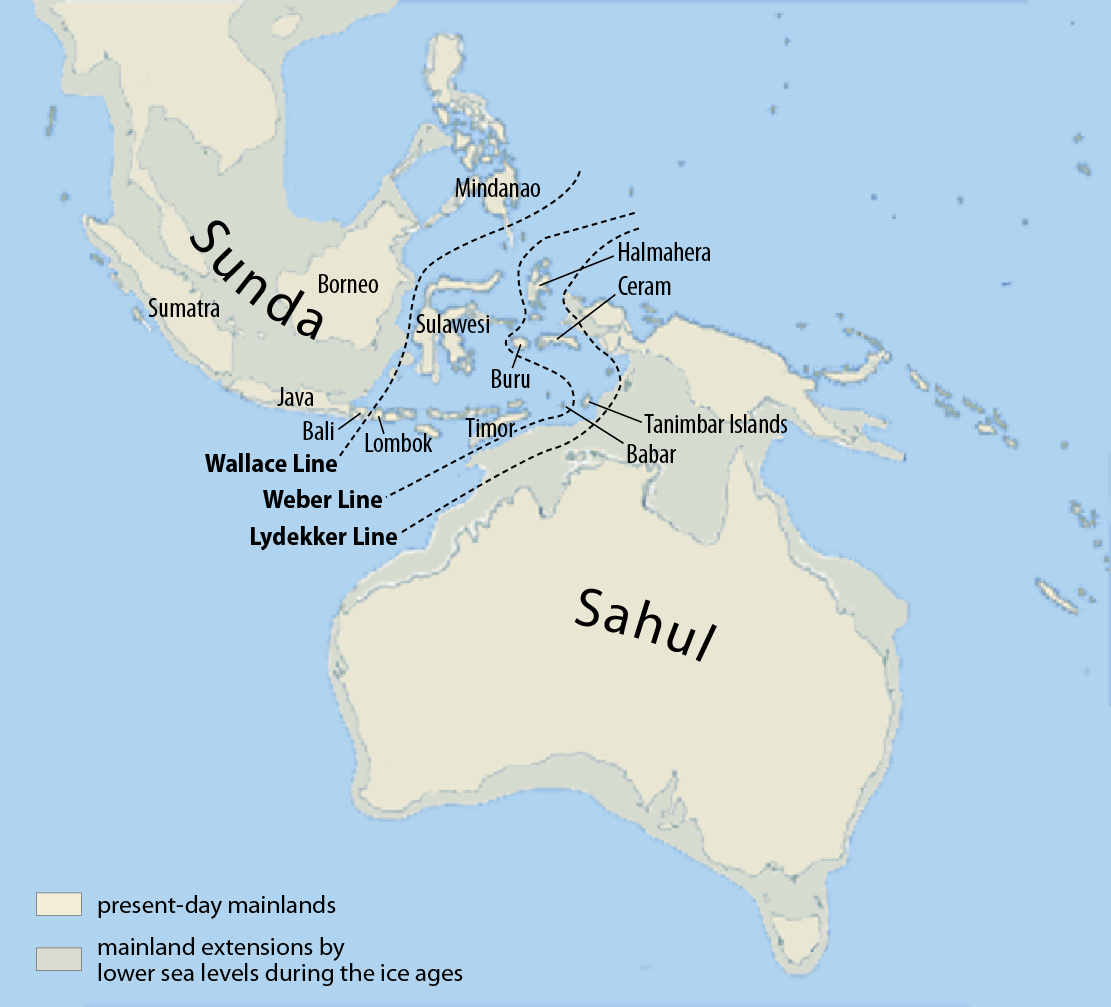
During the ice ages, the giant Sunda peninsula was grassland well suited to early homo and this is presumably how Java man came to be there 1.6-1.8 million years ago. The plain has been repeatedly flooded and has become much wetter during interglacials , and small populations were probably trapped in the jungle-covered islands in the eemian or even before - where they presumably evolved unique bloodlines. Later on when boats were invented (or possibly earlier following tsunamis) they would have made their way to the Sahul continent across the narrow deep water passages near Timor or further north.
The Indonesian archipelago pushes up where the Australian-Indian plate subducts under the Asian plate, and the area is subject to frequent volcanic activity. The massive supervolcanic eruption in Toba Sumatra around 75 000 years ago is said to have triggered a 6-10 year global volcanic winter and possibly triggering the last glacial period. It laid down 15 cm of ash over the whole of South Asia, killing forests in India. The eruption and subsequent tsunamis must have caused great loss of life, and might have driven any local early-sapiens inhabitants out of the archipelago towards India and Australia.
This type of environment would have been a real challenge even to erectus. In order to maintain viable breeding communities, and to protect against rising sea levels and other dangers associated with rapid global warming, slow cooling and drying events, and tectonic shocks, it might have been necessary to develop
Hasn't out-of Africa been proved by both paleontology and genetics?
I don't think so. It has not even been proved that erectus had its original base in Africa, though I do think this is likely.The paleontological evidence that early sapiens was in Africa consists of a piece of skull and some bone fragments from two sites in Ethiopia, dated to 190 000 BP. I am not a paleontologist but this is very limited information towards establishing what is a fairly fine level of difference erectus-sapiens. Given the substantial differences in skull types between individuals that undoubtedly existed at the time (just as it does now), these probably were not "anatomically modern humans".
The genetic evidence is more complicated and therefore equally complicated to disprove. Human genetics is still in its infancy and it has already made a number of glaring mistakes, absolute statements of fact that have been discredited within a couple of years. No doubt it will make many more before the true results are established.
The principal genetic results state that "genetic Eve" and "genetic Adam" lived in Africa. Relic "long thin lines" are infrequently encountered in non-recombinant DNA; and after the testing of over 300 000 men a pre-sapiens relic Y-DNA strain was encountered. When more mtDNA lines are tested the same will probably occur in the female lines.
Even if both Adam and Eve came from Africa, this does not imply that sapiens developed there. The particular mutations that define sapiens probably reside on only a couple of recombinant genes, as yet unknown. It is easy to tack these key genes onto relic DNA from earlier erectus, with the offspring appearing completely human while carrying pre-human non-recombinant lines.
The succeeding article, ????, shows that the Y-chromosome data does not particularly support Africa as the source of sapiens, and is slightly supportive of a south-east Asian origin.
We have not proved here that South east Asia or some other location is the cradle of sapiens, or that Africa is not - we are simply saying that a premature announcement of out-of-Africa was made (with thousands of conjectural articles following the lead) - and personally I do not think it is even likely, because lightning does not strike twice, especially in evolution.
[1]. Wikipedia. Björn Kurtén wrote "paleofiction" in the 1980s on this topic. Many bloggers have postulated the troll-neanderthal connection

When I read 15 years ago works by Prof.Milford Wolpoff regarding shovel-shaped incisors and flatness of the face amongst Chinese existing for hundreds of thousands of years I knew multiregional origin is the only way to explain origins of the humans.Later works by Alan Thorne regarding Australian Aborigines confirmed my logic.Finally the works by Professor
ReplyDeleteAnatole Klyosov totally proving DNA of Europeans doesn't have mutations typical for Africans demolished the OoA nonsense.I still cannot believe majority of so called DNA specialists repeat the OoA fairy tale.It's like majority of world mathematicians saying that 2+2=5.Very worrying,exposing fake science forced upon us.