 |
| sloping forehead |
The problem is that the individual mutations of sapiens are only useful taken together and for large groups of individuals - some of them are probably actually harmful in a situation of individual competition. It seem very unlikely that a small group of (say) San hunters placed in Africa a million years ago would survive, let alone prosper and and come to replace all others, in a territory already occupied by fully adapted erectus. Therefore it seems very likely that sapiens developed in a single location, expanded their numbers there or close by, and finally were driven by population pressure across the globe.
In that case, the kinds of modifications and adaptations we are seeking are those that
- allow higher birthrates or population levels than their homo competitors;
- give quicker access to key resources and permit key sites to be occupied and held;
- improve security or military success;
The modifications of sapiens are actually quite difficult to assess from an evolutionary perspective. Sapiens differs from other erectus in only a limited way physically - but, it is believed, a great deal in social and cultural organisation, and also in technology. The "leap" to the lower paleolithic somewhere round 40 000 years ago is is one of the great advances of humankind. It is thought to have occurred well after the development of "anatomically modern humans" - and long after the development of "big brains" - but this is uncertain.
In this article we look at the developments leading to the sapiens "finished product" - the physical changes to the skull, the new functions of the sapient brain, and technical, social and cultural developments.
The sapiens skull
It is generally agreed that the physical differences between sapiens and other erectus subspecies relate to the larger brain and to improved communications. Unlike physical changes earlier in the development of homo, these changes do not in themselves seem to have any adaptive purpose in survival. But as these changes have turned out to be ubiquitous and fixed, adopted by virtually every living homo, one should be cautious in saying they are accidental or derived.The main problem with identifying "anatomically modern humans" is that they are so similar to erectus, except in the skull - unlike neanderthalus which was so markedly physically different. Although most modern sapiens skulls can be immediately recognised by the round top and almost spherical brain case, the flat forehead, the lack of brow ridges and the prominent chin, some skulls of living people are lacking one or more of these features.
 |
| Brow ridge |
Coming up with an actual definition of an "anatomically modern" skull is not so easy, because of the wide distribution of modern skull types (Wolpoff 1986, Stringer 2013). Although most "modern" human skulls with their round top, flat forehead and fine dentition are easily identified and quite distinct from other homo, this is not the case with older skulls which often have "archaic features" such as large teeth, brow ridges, and measurement ratios which fall outside of the sapiens norm. It seems that the only real difference between sapiens and earlier homo is in the structure of the skull, which appears to be designed around speech rather than chewing.
In all earlier homo the principal buttressing is from the stiff brow ridge, which anchors the chewing muscles and the mandible to permit mastication of rough, raw food using heavy teeth. Early (and some modern) sapiens do have a brow ridge, but it is broken into several pieces by a hole or notch at the supraorbital foramen above the eye, where nerves pass from the inside to the outside of the skull.
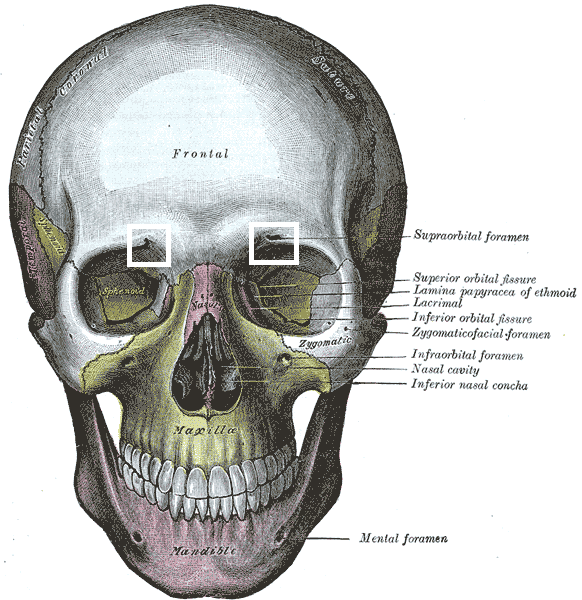
The protruding chin also is peculiar to sapiens. Its exact function is unknown but it is thought to anchor tendons that allow for detailed lip and tongue movements. Because ancient skulls often do not have the mandible, this clear defining feature may not be available for comparison.
Overall, most of the physical changes in the skull appear to make room for larger frontal lobes, and also to permit small movements of the facial apparatus that are our primary means of communication.
The bigger brain
The large brain continues a twenty million year trend from the primates through erectus - but somewhere a threshold of frontal lobe development was passed which made the brain function and operation qualitatively different. The human brain permits self awareness, planning, imagination and advanced problem solving. It allows for fully elaborated languages and the development of the abstract concepts which are a part of all human languages.The utility of this superb organ is obvious. What is not so obvious is - what are the evolutionary pressures that caused the bigger brain to continue developing for so many millions of years? Unless it is working fully, it is just an energy-guzzling nuisance. If, as it seems, the fully aware brain is produced by the same genes present in apes, with some enhancement and fine tuning - why does it have so much functionality not available to animal brains? For that matter - so far why are we unable to design anything remotely similar to it? It still seems like magic.
Some of the functions are useful to individuals or small groups, but it seems likely some of these would already have been fully developed long before sapiens.
- anticipation and causality: valuable in tracking, hunting, foraging and tool development; also in combat; advanced problem solving, using analogy or experiment rather than memory or imitation. One of the main innovations was the notion that everything must have a cause. Investigating these causes, finding alternative use of materials and tools, or applying analogues from one activity to another, made advances in technology possible.
- simple storytelling: recording past history of events that only happen rarely but in which past experience was useful
- personal communication: useful in preventing misunderstandings and limiting conflict; and necessary for trade and mating.
Extensions of these are valuable in creating group identity and expanding the local economy:
- Seeking of the ultimate cause, even for natural phenomena and the operation of random chance, is the foundation of religion. The systematic use of virtually everything in the environment and the sharing of that knowledge across a wide group of people must have led to the discovery and dissemination of medicines, implements, ornaments, and new food sources.
- advanced storytelling: myth and worship: creation of temporal identity through shared ancestors or gods;
- intergroup communication through diplomacy and shared culture.
Social organisation
Upper paleolithic sapiens hunter gatherers travelled in nomadic bands ranging from 25 to 100 - as baboons and chimpanzees do [1]. It is thought that other homo had smaller groups. Larger groups meant safety in numbers against attack by other homo, which for a million years had been the only natural enemy. Communities may have provided the necessary conditions for group nurture so that women could give birth annually - resulting in a population explosion. Greater division of labour was also possible in larger groups.If sapiens did in fact develop in a situation of rapid depletion of resources and periodic overpopulation, such as might have occurred with neanderthal on islands in a flooding plain, forms of aggressive organisation aimed at ritual warfare might have emerged as resources ran out - as among some Polynesians.
Alternatively, maintaining long trade chains could increase the standard of living in primitive economies, and regular intertribal gatherings could be used to find more diversity in mates, conduct trade and engage in wider social bonding.
Advanced language, culture and religion
The ubiquitous nature of culture and religion (or at least, animist beliefs) among "modern humans" suggests, as Darwin pointed out in his last book, that they have been actively selected for - and may be one of the primary cohesive forces binding larger groups together. Both culture and religion are highly predicated on the symbolism of language and ritual, and in the case of religion, on the idea of prime causes.Advanced language, ritual and culture exist for the purpose of forming cohesion between groups; increasing the size of the local economy and the possibility of shared technological advancement. The military power of the cohesive unit is enhances through superior skill in campaigns, through acting against foreigners or invaders or, in more aggressive situations, actively invading the territory of others and largely replacing them.
A tendency to engage in all these things is partly inheritable through genes. They are prima facie the main selective force acting in favour of the sapiens brain.
Language
In my opinion it is no accident that speech plays such a major role in courtship, or that so many women (and many men) require a context of conversation, flattery and voiced expression of shared intimacy before engaging in sexual relations, and actually crave it. While it is obvious why this should be necessary in establishing long term relationships, it is not so clear why practiced seducers are able to function by using these techniques to establish short-term liaisons. Receptivity to verbal cues appears to be heavily selected in females. It is possible that the superior romantic skills of sapiens also delivered the goods with neanderthal and other homo females, contributing to their ultimate absorption into the sapiens gene pool.A shared language is virtually necessary to resolve conflict by bands or individuals meeting on disputed territory. There is a story that New Guinean natives engage in a fairly elaborate set of questions or forms of address upon meeting a stranger. The purpose is to find out whether they are related or whether they should try to kill each other. In aggressive societies, being able to communicate significantly lowers the numbers of people whom it is necessary to kill, increasing longevity, improving security allowing for more births in a safe environment, preventing the theft of females, and increasing the prospect of mutual activities such as trade which can be beneficial for both sides.
Advanced speech and well-established communication is necessary for the management of any military campaign. At the extreme, Genghis Khan won his battles not so much through technical superiority but through a sophisticated network of riders carrying orders across a wide front. I am not suggesting that early sapiens engaged in widespread systematised warfare - though they were perfectly capable of it.
Culture and religion
Shared culture acts in a fairly similar way in promoting security and extending the reach of the band. Where marriages are arranged by families, they will almost always be to partners of the same culture, increasing and extending the group.When it comes to religion
that culture so often limits the choice o pair-bonding rituals form such a key part of religious expression.
Stringer, C (2012) What makes a modern human? Nature 485, May 3 2012
[1] Chimpanzees travel in groups of about 10, forming part of a loose larger group of up to a few hundred. They conduct organised wars and have been known to hunt down and completely eliinate the opposition.
Rasmussen, D T (ed) (1993). The origin and evolution of humans and humanness. Jones & Bartlett Learning. (Google Books).

No comments:
Post a Comment